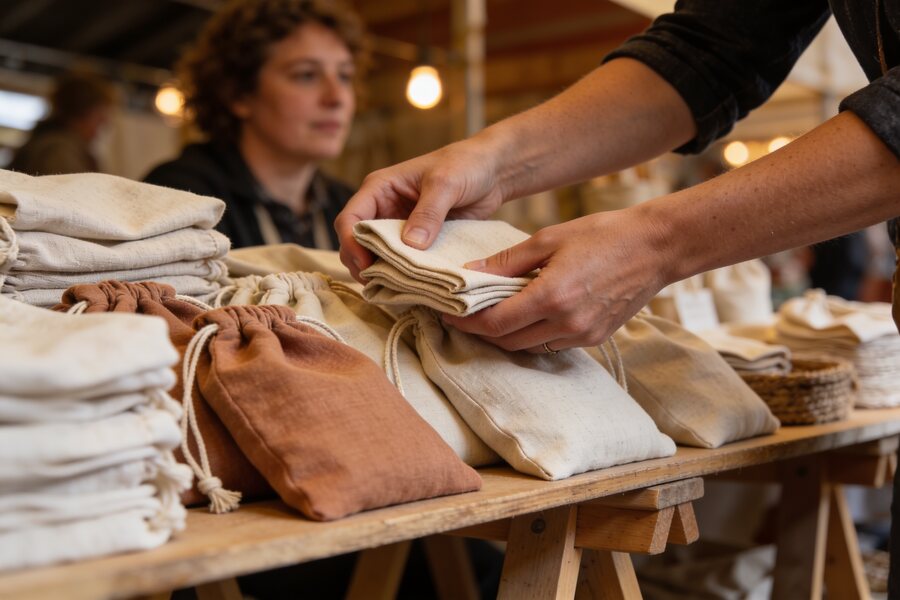
I am not a business adviser and I would never pretend to be one. What I am is someone who has spent a couple of years wandering round markets and car boots most Saturday mornings, which means I have stood in front of hundreds of tables and watched myself decide, in about two seconds, whether I am picking something up or walking on. So when a friend of a friend messaged me last week, about to do her first table at a craft market, asking what she should charge, I actually had an answer. Not a clever one. Just an honest one, from the customer's side.
Round the number, always
The one thing I say to nearly every trader who asks, and I have said it out loud at a stall before now, kindly, is this: if you were about to write £5.99 on that tag, just write £6. Nobody standing at a market table is doing sums to save a penny. All that 99p does is make me think you have copied a supermarket habit onto something handmade, and it looks like you are trying to trick me into thinking it is cheaper than it is. A clean number looks confident. It looks like you know what your work is worth. Odd pricing belongs on a shelf under strip lighting, not on a trestle table in the rain.
The same goes for anything with a lot of nines and pence in it generally. If your card earrings are £3.50, fine, that is a real half a pound and people can work with it. But the moment a price starts looking like it was set by a machine rather than a person, I start wondering what else about the stall is copied rather than considered.
Price the thing you'd be sad to lose, higher
I have watched traders undersell the one item on their table that is actually brilliant because they are embarrassed to ask for more than everything else. Don't do that. If you have made one thing that took you three times as long, or that you genuinely love, or that nobody else at the market has, it should cost more, and it is fine to say why, briefly, if someone asks. "That one's the one I kept for myself for a bit" does more for a sale than any sign ever could. People do not mind paying more for the piece that clearly means something to the person who made it. They mind paying the same price for everything because it suggests nothing on the table was made with any more care than anything else.
And please, price the first thing someone sees on your table a bit higher than you think. It sounds backwards, but the first price I read at a stall sets what I expect everything else to cost. If that first thing is dirt cheap, I assume the whole table is discount stock, and I stop looking properly. If it is priced like it matters, I look at the rest of the table the same way.
Say the price out loud on the tag, not in your head
The traders I actually stop for are the ones whose prices are visible before I have to ask. Nothing makes me walk past faster than having to catch someone's eye and say "how much is this one then," especially if you are mid-conversation with another stallholder or eating a bacon roll, which, fair enough, it is early. A handwritten tag, even a scrappy one, tells me you have thought about your pricing rather than making it up as I ask. It also means I don't have to do the slightly awkward thing where I put something down again because the number that comes back is more than I was expecting and I've already committed my face to buying it.
If something genuinely has a bit of room to move, that is a different conversation, and most regular market-goers know which stalls those are. But don't leave every price open just because you are not sure. Being unsure reads as the stall being unsure, not as generosity.
Don't chase the stall next to you
I have seen two traders selling almost the same sort of thing quietly drop their prices against each other over the course of a morning, and it never ends anywhere good. Customers notice. It starts to feel less like a market and more like a discount rail, and the thing that made either stall interesting in the first place, the actual maker behind it, disappears. Price your own work for what it took you and what it is worth to you, not for what the table three along is doing. There is room at a market for two people selling similar things at two honest prices.
None of this is a formula. It is just what actually changes my mind when I am standing there deciding. If you want more of this sort of thing, the small stuff nobody tells you before your first stall, I put it all together properly in What Makes Me Stop, my free guide for anyone selling at a market for the first time. It has all the bits I could not fit into one Saturday morning conversation.